








Originally published February 28, 2024 · Updated September 2026
The most effective vertical storage idea for most closets is a second hanging rod. Double-hang rods at about 40 and 80 inches roughly double the hanging space for shirts, pants, and jackets on the same wall. Keep a single-hang section for anything longer than about 38 inches, put everyday shelves at or below eye level, and use the space above the top rod for bins, luggage, or a pull-down rod.
Key Takeaways
- A single rod uses about half a closet's usable height. A second rod roughly doubles the hanging space for shirts, pants, and jackets.
- Double-hang needs about 40 inches per tier. Anything longer than about 38 inches on the hanger needs a single-hang section.
- For daily items, the highest comfortable shelf is about eye level. The highest shelf you can reach without a stool is roughly your height plus 12 to 16 inches.
- Wall-hung rail systems cost less. Floor-based systems secured to the wall carry more weight and make room for drawers.
- Where a square foot of home costs $250 to $600 or more, getting more out of the wall is the least expensive space you'll ever add.
Look under the shirts hanging in a standard closet and you'll find about 3 feet of empty wall and one shoe that wandered off. Above them, there's one shelf, then a stretch of bare wall all the way to the ceiling. Most closets aren't too small. They have plenty of room above and below the clothes that isn't doing anything yet. Here's how to put it to work.
How much space does a second closet rod add?
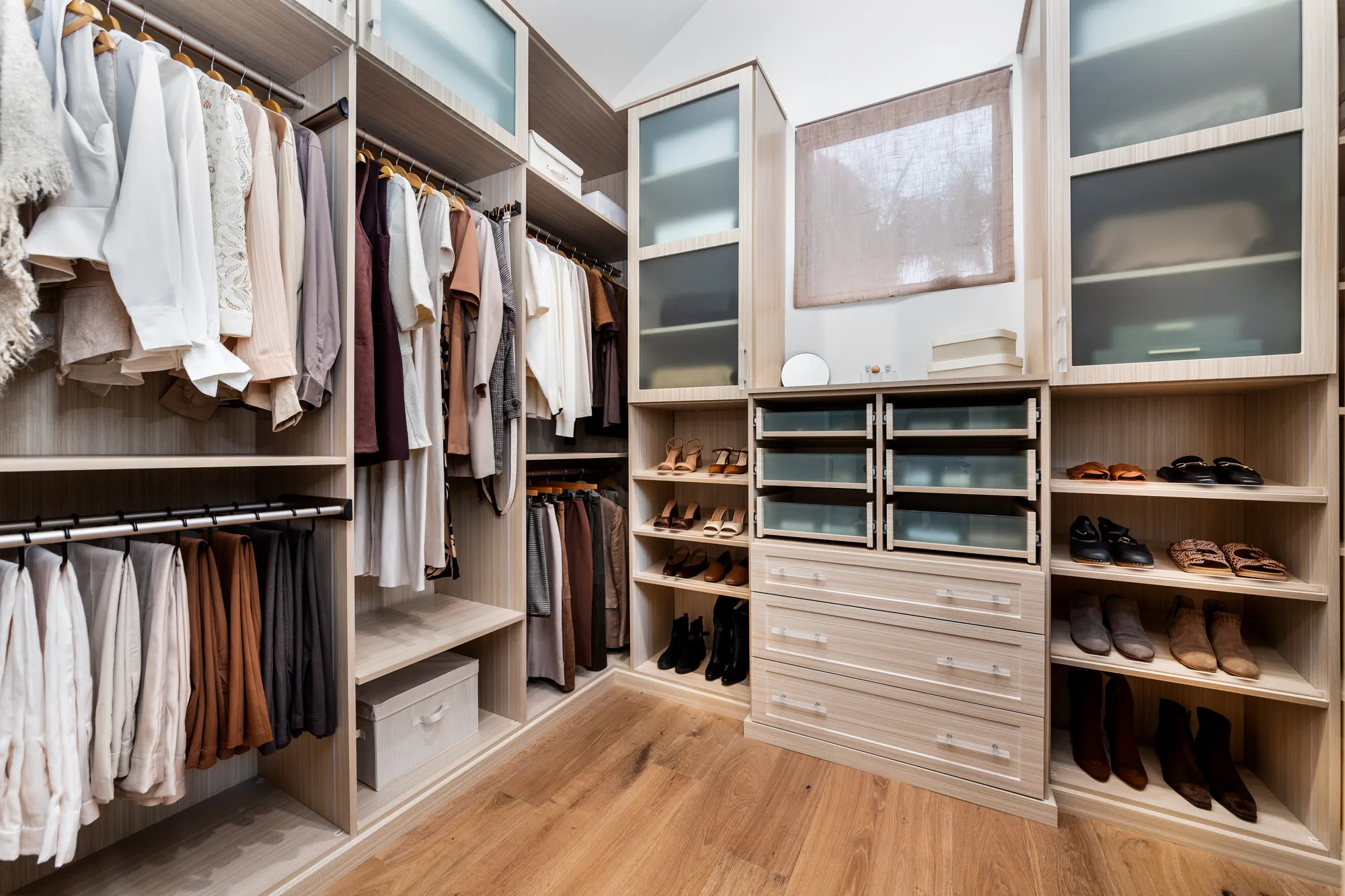
A second rod adds one linear foot of hanging space for every foot of closet you convert. The math is easy because the second rod runs the same length as the first. Convert a 6-foot reach-in fully to double-hang, and you go from 6 to 12 linear feet of hanging. Convert half of it, and you get 9 feet, with the other 3 left at full height for dresses and coats.
What that means in actual clothes depends on your hangers. On standard hangers, a foot of rod holds about 8 to 10 shirts. On slim, non-slip hangers, it's closer to 12 to 15. A 6-foot double-hang closet on slim hangers can hold well over 100 shirts, which is more shirts than most people own. That's the point: room for every shirt and jacket, and the sweaters can stay folded on a shelf, where they keep their shape.
The space above the rods counts as well. In an 8-foot closet, a top shelf at about 84 inches leaves roughly 12 inches to the ceiling, enough for a row of bins or the luggage. In most closets that space holds exactly nothing. Custom closets are designed to use the whole wall, floor to ceiling, and our panels run up to 96 inches tall as standard, with taller options for high ceilings.
Double-hang vs. single-hang: which clothes fit where?
Double-hang works when each tier gives clothes about 40 inches of drop. With rods at about 40 and 80 inches, anything that hangs 38 inches or less fits. Anything longer drags on the lower rod or pools on the floor. Here's where common garments land.
| Garment | Length on the hanger | Where it hangs |
|---|---|---|
| Folded pants | About 24-28 in | Double-hang, either tier |
| Blouses and knit tops | About 26-30 in | Double-hang, either tier |
| Dress shirts | About 30-36 in | Double-hang, either tier |
| Blazers and suit jackets | About 32-38 in | Double-hang, though the upper tier is safer for long sleeves |
| Full-length pants hung by the cuff | About 40-44 in | Single-hang, or fold them over the hanger instead |
| Knee-length dresses and tunics | About 38-45 in | A medium-hang section, with the rod at about 54-60 in |
| Long coats | About 40-48 in | Single-hang, with the rod at about 66-72 in |
| Maxi dresses and robes | About 50-60 in | Single-hang, with the rod at about 72 in |
Most closets work best with a mix. Measure how much rod your long items take up now, give them exactly that much single-hang space, and double-hang everything else. Many people find their "long hanging" is two coats and one dress they wore to a wedding in 2019, which fits in about 18 inches.
How high can a closet shelf be and still be useful?
A shelf is only useful if you can reach it. Eye level is the ceiling for anything you use every day, since you need to see what you're grabbing. The top of your reach, meaning the highest shelf you can get something off without a step stool, is roughly your height plus 12 to 16 inches. Here's how that works out.
| Your height | Everyday shelf (about eye level) | Highest shelf without a stool | Good for the top |
|---|---|---|---|
| 5 ft 0 in | Up to about 56 in | About 72-74 in | Light bins and keepsakes |
| 5 ft 4 in | Up to about 60 in | About 76-78 in | Out-of-season clothes |
| 5 ft 8 in | Up to about 64 in | About 80-82 in | Luggage and extra bedding |
| 6 ft 0 in | Up to about 68 in | About 84-86 in | Almost anything light |
These are approximate, since arms vary, but they explain a lot of closets. A standard top shelf at 80 to 84 inches is perfectly usable for someone who's 6 feet tall and mostly decorative for someone who's 5 foot 2. If you share a closet, give the taller person the higher rod and the upper shelves, and keep the shorter person's everyday things between waist and eye level. Drawers follow the same logic: our designers keep the top of any drawer at 56 inches or lower, so you can see into it and pull it open safely.
For hanging, a pull-down rod solves the reach problem. It mounts high and swings down to arm's height on a handle, which makes the space above a standard rod usable for everyday clothes instead of storage. Ours fit sections from 28 to 42 inches wide on panels at least 16 inches deep. It's one of the few closet accessories that adds capacity instead of just organizing what's already there.
Wall-hung vs. floor-based vertical systems
There are two main ways to build vertical storage, and they handle weight differently.
Wall-hung rail systems use a horizontal rail screwed to the wall, with vertical standards hanging from it to hold shelves, rods, and baskets. They're inexpensive, easy to adjust, and fine for light loads. The limit is the wall. Every pound hangs from the fasteners, so the rail has to hit studs, and the shelves are cantilevered off the standards instead of supported at both ends. That's also why these systems rarely include drawers.
Floor-based panel systems stand on the floor, with vertical panels running floor to ceiling, secured to the wall for stability. The floor carries the weight, so shelves are supported on both ends, drawers and towers are possible, and heavy loads stay put. That's how Closet World closets are built: floor-mounted panels secured to the wall, not hung from it. Shelves span no more than 42 inches between panels, so a stack of jeans doesn't turn into a slow-motion sag.
Freestanding units like bookcases, shoe towers, and wardrobes add vertical storage with no installation, but anything tall needs to be anchored to studs. Cal OES and FEMA earthquake guidance both call for securing the tops of tall, top-heavy furniture, which applies to every California and Las Vegas home.
Why vertical space is worth more in California and Las Vegas
Floor space in California and Las Vegas homes is expensive. Redfin's August 2026 data puts the median sale price per square foot at about $621 in Los Angeles, $254 in Las Vegas, and $250 in Fresno. A 2-by-6-foot reach-in takes up 12 square feet of floor. In Los Angeles, that's more than $7,000 of home price, whether it holds 6 feet of shirts or 12.
That's the case for vertical storage in one number. You can't buy one more square foot of closet without a remodel, but you can use the height above and below the rod you already have. A double-hang section, a pull-down rod, and shelving all the way to the ceiling can nearly double a closet's capacity in the same footprint. It's why our designers measure the full height of every wall, including the part you need a stool to see.
Other ways to use the wall
Once the rods and shelves use the full height, a few smaller moves take care of what's left:
- Hooks and valet rods on the side panels get bags, belts, and tomorrow's outfit off the floor and the doorknob.
- Over-the-door organizers use the back of a door that swings into the room, which is especially handy for shoes in a small closet.
- Stackable bins sized to the shelf keep folded things in columns instead of piles, so you can pull one bin without starting an avalanche.
For shelf depths and spacing, see our guide to closet shelving ideas. For which add-ons are worth the space they take, read our comparison of closet accessories.
Frequently asked questions
What height should double-hang closet rods be?
Set double-hang rods at about 40 and 80 inches. That gives each tier roughly 40 inches of drop, enough for shirts, blouses, jackets, and pants folded over the hanger.
How much space does a double-hang closet add?
A double-hang section doubles the hanging space for every foot of rod you convert. A 6-foot closet goes from 6 to 12 linear feet of hanging.
How high should the top shelf in a closet be?
Most top shelves sit at 80 to 84 inches. The highest shelf you can reach without a stool is roughly your height plus 12 to 16 inches, so shorter users do better with a top shelf closer to 72 to 76 inches, or a pull-down rod.
What clothes can't go in a double-hang closet?
Anything longer than about 38 inches on the hanger, including long coats, maxi dresses, robes, and full-length pants hung by the cuff. Give those a single-hang section at about 66 to 72 inches.
Make every inch of the wall count
Vertical storage is closet math: a second rod where the clothes are short, shelves where you can reach them, and the wall above working as hard as the space at eye level. In homes where every square foot costs this much, that math adds up fast.
We've been designing closets for California and Las Vegas homes since 1991, and every system is built in our own factory to your closet's measurements, floor to ceiling. Book your FREE in-home design consultation, and we'll show you how much more your closet can hold (and where that missing shoe went).