










Key takeaways
- Most folded clothing fits on 12- to 14-inch-deep shelves spaced 10 to 12 inches apart. Taller stacks are the ones that end up on the floor.
- Our designers cap closet shelves at 42 inches wide between supports, and at 26 inches for books or other heavy loads, unless the shelf gets extra support.
- Adjustable shelves suit closets whose contents will change. Every section still needs at least one fixed shelf to keep the frame square.
- A shallow closet in an older home can still hold a full wardrobe once the hanging turns to face forward and the shelving takes over the depth.
Originally published June 17, 2024 · Updated September 2026
The best closet shelving ideas start with two measurements: shelf depth and the space between shelves. Most folded clothes fit on 12- to 14-inch-deep shelves spaced 10 to 12 inches apart. Linens need 14 to 16 inches of depth, and shoes need only 6 to 8 inches between shelves. Keep each shelf 42 inches wide or less between supports, or 26 inches for books and other heavy loads, so it doesn't sag.
Key Takeaways
- Most folded clothing fits on 12- to 14-inch-deep shelves spaced 10 to 12 inches apart. Taller stacks are the ones that end up on the floor.
- Our designers cap closet shelves at 42 inches wide between supports, and at 26 inches for books or other heavy loads, unless the shelf gets extra support.
- Adjustable shelves suit closets whose contents will change. Every section still needs at least one fixed shelf to keep the frame square.
- A shallow closet in an older home can still hold a full wardrobe once the hanging turns to face forward and the shelving takes over the depth.
Somewhere in your closet there's a stack of sweaters that falls over every time you take one from the middle. You pull the gray one, the navy one slides sideways, and by Thursday the whole stack is a heap you've stopped trying to refold. That's not a character flaw, and it's not a folding problem. The shelf above is too far away, so the stack keeps growing until it can't stand up. Somewhere past four sweaters, gravity wins.
How deep should closet shelves be?
Closet shelves should be 12 to 14 inches deep for folded clothes and most shoes, and 14 to 16 inches deep for linens and bulky sweaters. Go deeper than 16 inches and you start building a second row behind the first. Nobody has ever gone looking for the sweater in the second row. They buy a new sweater.
Depth is only half the job. The other half is what sits on the shelf, and that's where most closets go wrong. A shelf spaced for jeans holds four pairs of flats and a lot of air. A shelf spaced for shoes can't take a sweater without crushing it flat. The fix is to plan shelves around what you own, which is how custom closets are designed from the start.
How far apart should closet shelves be?
Here's the spacing that works for the things people store most. These are the numbers our designers start from, then adjust to what's actually in your closet (including the boots you swear you'll wear again).
| What's on the shelf | Shelf depth | Space between shelves | Why it works |
|---|---|---|---|
| Folded sweaters | 12-14 in | 10-12 in | Three or four sweaters per stack, which is about where a stack stops standing up on its own. |
| Folded T-shirts and jeans | 12 in | 8-10 in | Thinner folds, so you fit more shelves in the same section. |
| Flats, sneakers, and sandals | 12 in | 6-8 in | One pair per slot, with room to lift a pair out without taking the neighbors with it. |
| Heels and ankle boots | 12-14 in | 8-10 in | Heels need the height. Ankle boots need the height and a little depth. |
| Tall boots | 14 in | 16-18 in | Or give them floor space and a boot shaper, and let them stand up for themselves. |
| Storage bins | Bin depth plus 1 in | Bin height plus 2 in | Two inches is enough to tip the bin forward and slide it out. |
| Sheets and towels | 14-16 in | 12-15 in | A folded sheet set is wider and taller than any sweater stack. |
| Carry-on suitcase | 14 in, lying flat | 10-12 in | A standard carry-on is about 22 x 14 x 9 inches, so it fits a 14-inch top shelf on its side. |
| Checked suitcase | 20 in or more | 14 in or more | A 27- to 30-inch bag won't fit a reach-in shelf. It belongs on a walk-in floor or in the garage. |
The top shelf in most reach-ins sits at about 80 to 84 inches. That's fine for luggage and keepsakes. It's not fine for anything you need weekly. If reaching it takes a step stool, store things there you'd be willing to get a step stool for.
How wide can a closet shelf be before it sags?
A standard 3/4-inch closet shelf should span no more than 42 inches between supports for clothing, and no more than 26 inches for books or anything else heavy. Those are the limits our designers work to. Past 42 inches, a shelf needs extra support, like an L-bracket underneath or a cleat along the back, and at about 48 inches it's time for another panel.
The reason is physics, and it's not forgiving. Sag doesn't grow a little as a shelf gets wider. It grows a lot. Double the span, add the extra jeans that now fit on it, and the middle can dip more than ten times as far. Woodworkers treat roughly 1/32 of an inch of sag per foot as the point where you can see it, and it gets worse over time under the same load. That's why the 5-foot shelf in a builder closet has a visible dip in the middle by year three, right under the jeans.
| What's on the shelf | Maximum width between supports | The trade-off |
|---|---|---|
| Folded clothes, shoes, bins | 42 in | The standard limit. Shelves sit between panels, supported on both ends. |
| Books, files, or other heavy loads | 26 in | Heavy things need shorter spans. A shelf of hardcovers weighs more than you'd think. |
| Anything 42 to 48 in wide | 48 in, with L-brackets or a cleat | Possible, but the support has to be designed in, not added after the dip shows up. |
| Wider than 48 in | Split it with another panel | Two shorter shelves always beat one long one that bows. |
| Hanging rods | 42 in | Longer rods need a center support, or they sag like the shelves do. |
Two upgrades help with weight. Cleated shelves are fixed in place with supports along the front and back, which adds real stiffness. Thicker 1 1/8-inch shelves are available in some finishes and look substantial, but the span rules still apply. Thickness is no excuse for a longer shelf.
Wire shelving deserves an honest word here, too. It's inexpensive, it breathes, and it's fine in a pantry. In a clothes closet, it leaves a waffle print on folded sweaters, drops small items through the gaps, and dips wherever the stack is heaviest. It's the right call in rooms where none of that matters.
Adjustable vs. fixed shelving: which one do you need?
Adjustable shelves rest on pins set into a line of pre-drilled holes, so you can move them as your wardrobe changes. Fixed, or locked, shelves are secured into the panels. They can't move, but they hold the section square and stiff. A good system uses both: at least one locked shelf per section for structure, with adjustable shelves around it.
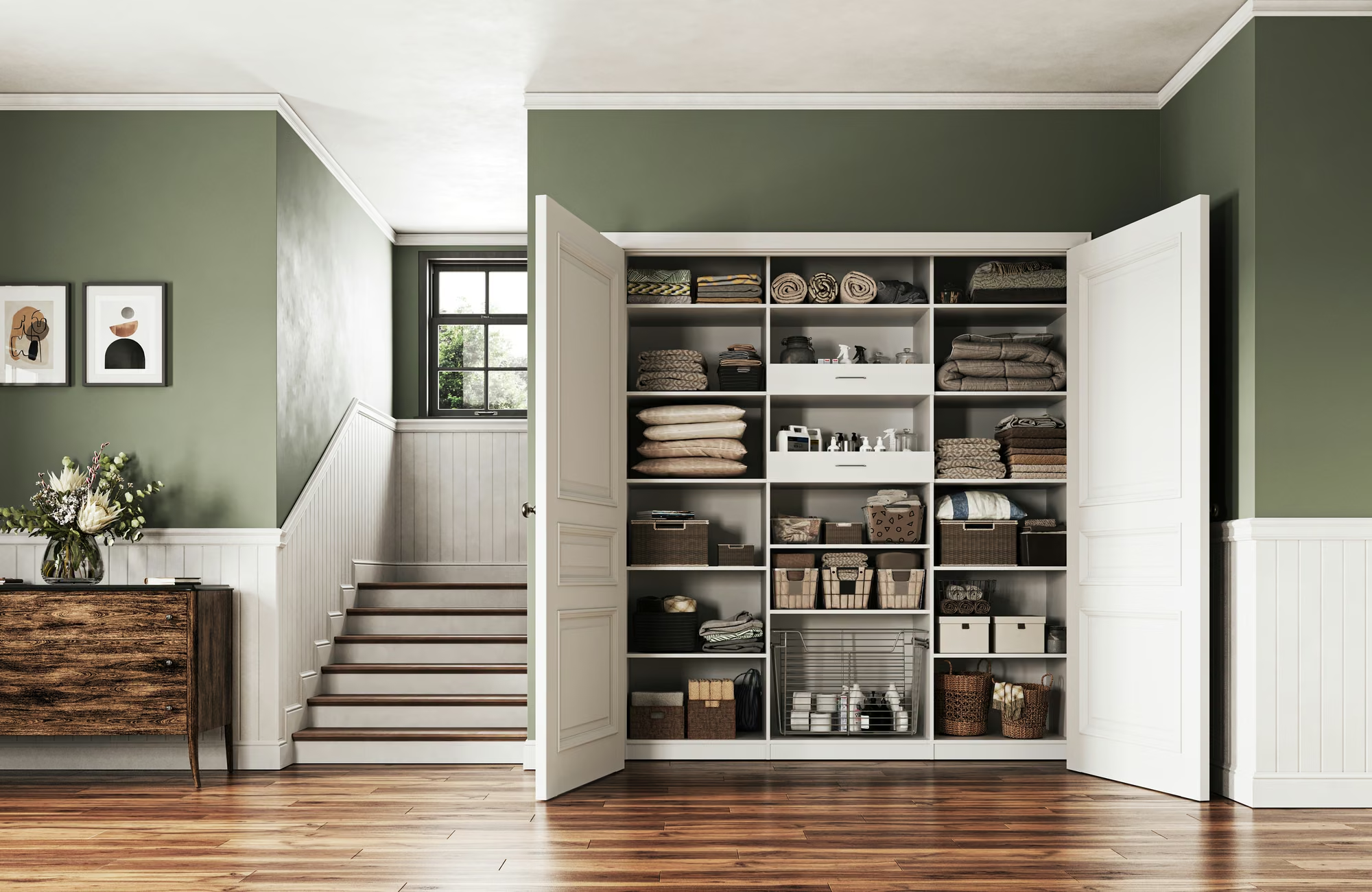
Choose mostly adjustable shelving when the closet's contents will change. That covers a kid's closet, a shared closet, a guest room that becomes an office, and anyone who owns a lot of shoes and keeps buying more. Choose more fixed shelving for anything that stays put for years, like a linen closet or a luggage shelf.
The only catch with adjustable shelving is that someone has to adjust it. If the spacing hasn't moved in five years, you paid for flexibility and used it zero times. That's a very common outcome, and it's fine. The option is still there the day you finally switch to folding your jeans.
How do you add shelving to a shallow closet?
A lot of closets in older California and Las Vegas homes, including plenty of postwar tract houses, were framed shallower than today's 24-inch standard. A hanger needs about 20 to 22 inches once you add the clothes on it. In a 20-inch closet, the shirts hit the back wall, the sleeves get caught in the door, and everything hangs at a slight angle, as if the whole wardrobe is trying to leave.
Four fixes work well, alone or together:
- Turn the hanging to face forward. Short rods set perpendicular to the back wall, or pull-out valet rods, let clothes hang front to back, so depth stops being the limit.
- Let shelves and drawers take over the depth. A 20-inch closet is too shallow for side-to-side hanging but deeper than any shelf needs to be. Give it 12- to 14-inch shelving and drawers, and move the hanging to a wall where it fits.
- Rethink the doors. Bifold doors fold back into the opening, and sliding doors ride on tracks that take up 3 1/2 inches or more of depth. Doors that swing out, or no doors at all, can win back the inch that decides whether hangers fit.
- Open the wall. In some remodels, removing the old closet wall and building a full-depth system into the room works better than patching a closet that was undersized from day one.
Our designers see this constantly in older homes, and it's one of the clearest cases for going custom: the system is built to the closet you actually have, not the 24-inch closet a store-bought kit assumes. If you're not sure what yours measures, our guide to how deep closets are walks through the standards and what happens below them.
Reach-in closet shelving ideas
A standard reach-in is about 24 to 30 inches deep and 4 to 8 feet wide, with one rod at about 66 inches and one shelf above it. It's the least efficient closet in the house. The shelf sits too high to use, the space under the shirts sits empty, and the floor quietly becomes the shoe department.
Put the height to work first. Double-hang rods at about 40 and 80 inches turn one row of shirts into two, and one section left at full height handles dresses and coats. Then bring shelving into the room: a narrow tower of 12-inch shelves in the center or at one end holds folded clothes and shoes where you can see them. Shallow drawers at waist height catch what would otherwise live on top of the dresser, like the watch, the sunglasses, and the receipt you're keeping for reasons.
Mind the corners. The back corners of a reach-in, behind the door frame, are the hardest spots to reach. They're good for off-season storage and bad for anything you need on a Tuesday.
Walk-in closet shelving ideas
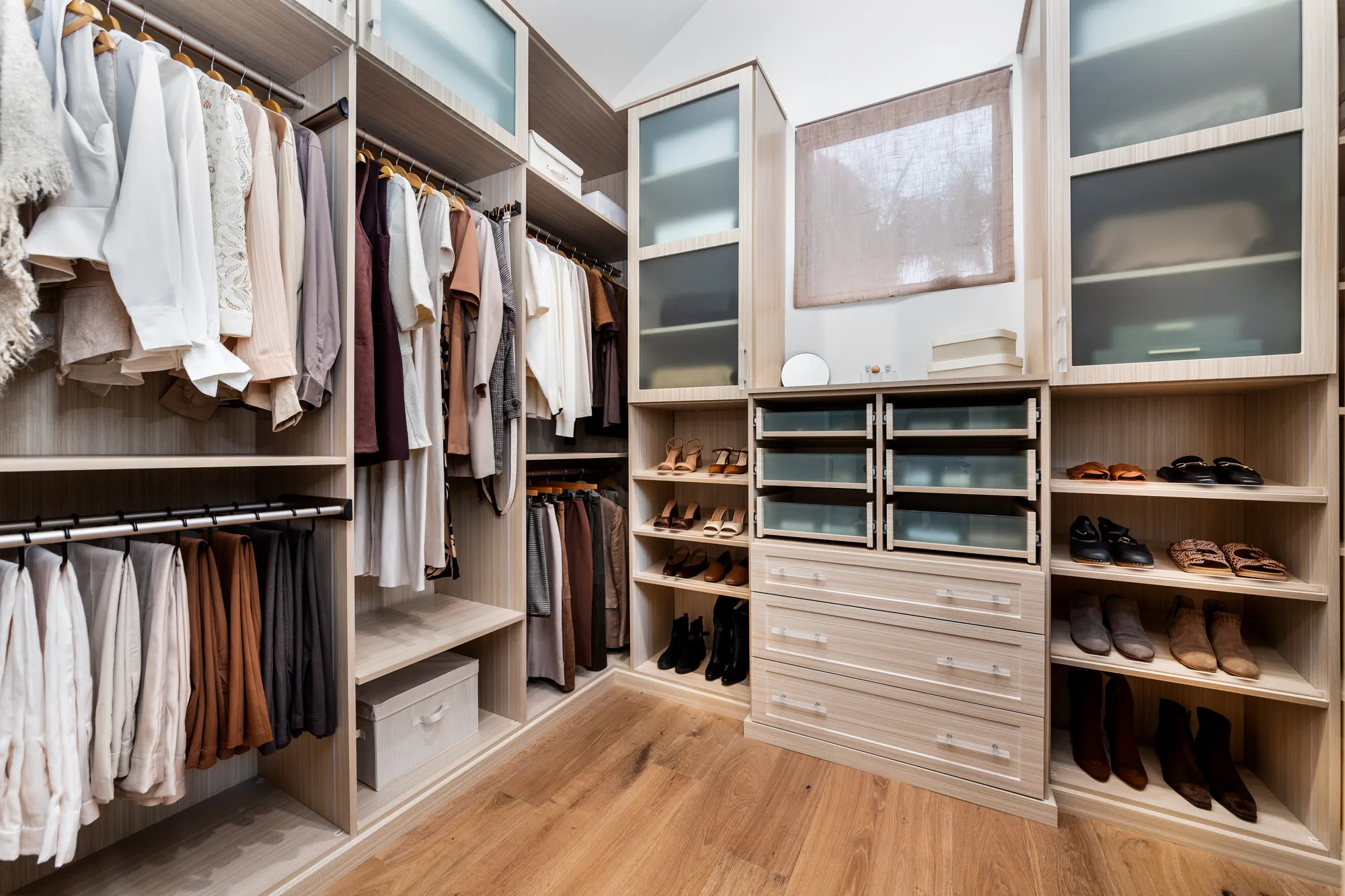
Walk-ins offer more shelving options and more ways to get them wrong, because there's more room for random decisions. Keep a walkway of at least 36 inches so you can turn around with an armful of laundry. Hanging on both sides takes about 24 inches each, so a double-sided walk-in needs roughly 7 feet of width before it's comfortable.
Give each category its own zone: one tower for folded clothes, a run of shoe shelving at 12 to 14 inches deep, and deeper 16-inch shelving for handbags standing upright instead of stacked. Everyday things go between waist and shoulder height. The top shelf is for luggage and the holiday sweater, which gets worn once a year and deserves a place that reflects it.
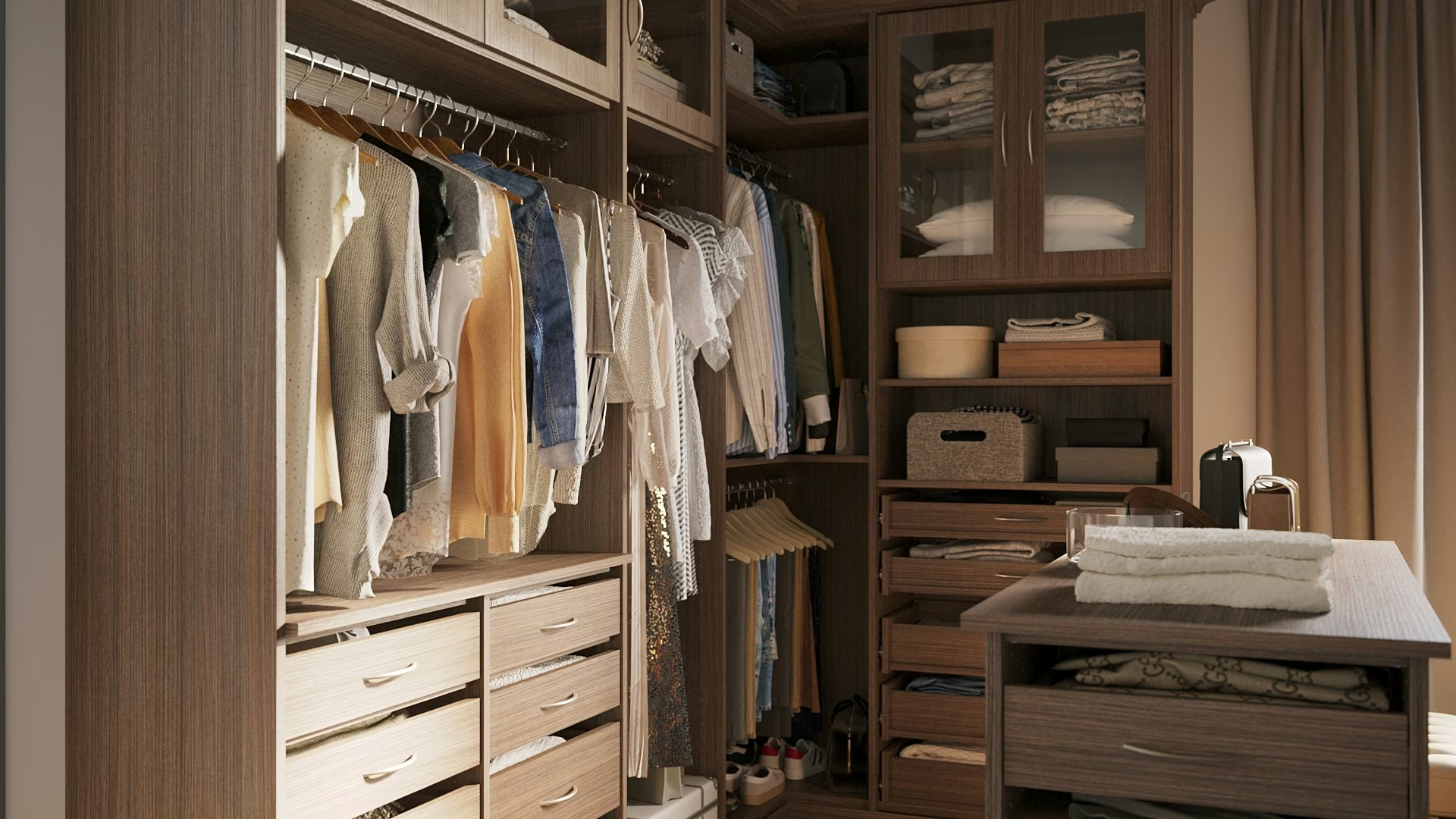
If the walk-in is wide enough for an island, its drawers can take over the dresser's job and give you a place to fold. For more ways to use the height, our post on vertical storage ideas covers the double-hang math and how high a shelf can go before it stops being useful.
Wardrobe and armoire shelving ideas
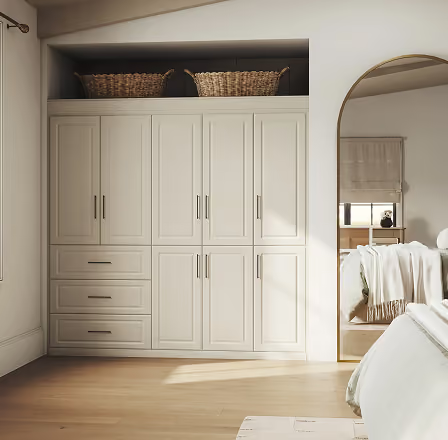
Freestanding wardrobes and armoires are usually 20 to 24 inches deep, which puts them in the same category as a shallow reach-in. The same rules apply on a smaller scale: 12- to 14-inch shelves, spacing matched to the contents, and the full width for hanging, since a wardrobe rod never has an inch to spare.
Pull-out shelves are the upgrade that pays off most in a wardrobe. Because the cabinet is closed, the back half of a fixed shelf lives in the dark, where the good scarf goes to be forgotten. A shelf that slides out brings the back half to you. The inside of the doors can carry a tie rack, a belt hook, or a slim mirror.
In California, a tall wardrobe also needs to be anchored to the wall studs. Earthquake preparedness guidance from Cal OES and FEMA calls for securing the tops of tall, top-heavy furniture, and a wardrobe full of clothes is exactly that.
Frequently asked questions
How deep should closet shelves be?
Most closet shelves should be 12 to 14 inches deep. Linens and bulky sweaters do better on 14- to 16-inch shelves. Past 16 inches, things get stacked two rows deep, and the back row gets forgotten.
How far apart should closet shelves be for folded clothes?
Space shelves 10 to 12 inches apart for sweaters and 8 to 10 inches for T-shirts and jeans. That keeps stacks to three or four items, which is about the limit before they tip.
How wide can a closet shelf be without sagging?
A standard 3/4-inch closet shelf should span no more than 42 inches between supports for clothing, or 26 inches for books and other heavy loads. Wider shelves need L-brackets or a cleat underneath.
Are adjustable closet shelves worth it?
Yes, if the closet's contents will change, as in a kid's closet or a shared one. Even with adjustable shelves, a well-built system keeps at least one fixed shelf per section so the frame stays square.
Build the shelving around what you own
Good closet shelving is mostly arithmetic: the right depth, spacing that matches what you store, and spans short enough to stay flat. Get those right, and a closet that's been fighting you for years suddenly holds everything, with a little room to spare.
We've been designing custom closets for California and Las Vegas homes since 1991, and every system is built in our own factory to your closet's real measurements, shallow walls and awkward corners included. Book your FREE in-home design consultation, and we'll measure, plan, and design shelving for everything you own (the boots included).
Frequently asked questions
How deep should closet shelves be?
Most closet shelves should be 12 to 14 inches deep. Linens and bulky sweaters do better on 14- to 16-inch shelves. Past 16 inches, things get stacked two rows deep, and the back row gets forgotten.
How far apart should closet shelves be for folded clothes?
Space shelves 10 to 12 inches apart for sweaters and 8 to 10 inches for T-shirts and jeans. That keeps stacks to three or four items, which is about the limit before they tip.
How wide can a closet shelf be without sagging?
A standard 3/4-inch closet shelf should span no more than 42 inches between supports for clothing, or 26 inches for books and other heavy loads. Wider shelves need L-brackets or a cleat underneath.
Are adjustable closet shelves worth it?
Yes, if the closet's contents will change, as in a kid's closet or a shared one. Even with adjustable shelves, a well-built system keeps at least one fixed shelf per section so the frame stays square.

CW Man’s two cents
Let’s plan the room you actually have
Your designer plans around your space, your things and your routine. Free in-home or virtual design consultation, in as little as 90 minutes.