








Originally published April 3, 2018 · Updated September 2026
The closet accessories worth adding are the ones that add capacity or save a step every day. Pull-down rods, pant racks, drawer inserts, and well-spaced shoe storage do both, and valet rods and belt racks earn their place at a small cost. Two popular add-ons usually don't pay off at typical closet sizes: islands in walk-ins narrower than about 8 to 10 feet, and built-in hampers in reach-in closets.
Key Takeaways
- Judge every accessory by what it adds and what it takes. The best ones add capacity or save time without eating hanging space.
- A pull-down rod adds a full tier of hanging in space most closets can't reach.
- A pant rack in a 24-inch section holds 18 pairs of pants in about 2 feet of wall.
- Our designers plan walk-ins on a 24-inch rule: 24 inches to hang and 24 to walk. An island needs about 8 feet of width with hanging on one wall, or about 10 feet with hanging on both.
- In homes that cost hundreds of dollars per square foot, an accessory that uses up hanging space has to be worth more than the space it took.
Every closet has one accessory that seemed like a great idea in the showroom and now holds a single scarf. Maybe it's the jewelry tray with two earrings and a paper clip, or the tie rack in a house where nobody has worn a tie since the last wedding. The accessory wasn't bad. It just wasn't worth the space it took, and in a closet, space is the whole point.
How do you decide which closet accessories are worth it?
An accessory is worth it if what it adds is worth more than what it takes. Every accessory takes something: a section of rod, a drawer's worth of depth, or floor you'd otherwise walk on. The good ones give back more than they take, as added capacity or as a daily step you no longer have to take. The disappointing ones look wonderful on the first day and turn into the most expensive shelf in the closet. A good custom closet design sorts one from the other before anything gets built.
Here's how the most popular accessories compare. Costs are relative, from $ (inexpensive) to $$$$ (a major line item), since actual pricing depends on size, finish, and collection.
| Accessory | Capacity gained | Space it uses | Relative cost | Best for | Best-fit closet |
|---|---|---|---|---|---|
| Pull-down rod | A full extra tier of hanging above the main rod | Space above the rod that's usually out of reach | $$ | Anyone who can't reach an 80-inch rod | Sections 28 to 42 inches wide, with 8-foot or taller ceilings |
| Pant rack | 12 pairs in an 18-inch section, 18 in a 24-inch section, 24 in a 30-inch section | 24 to 32 inches of height in one section | $$$ | Anyone whose pants live folded in a pile | Reach-ins and walk-ins |
| Valet rod | A staging spot for one or two outfits | A 12-inch rod that retracts into the side of a panel | $ | Planning tomorrow's outfit or hanging dry cleaning | Any size |
| Drawer inserts and dividers | More items in the same drawer, sorted and visible | None. It works inside drawers you already have. | $ | Jewelry, socks, watches, and earrings | Any closet with drawers |
| Shoe shelving or shoe drawers | About 3 pairs per 24-inch shelf, or 2 to 4 rows in a pull-out shoe drawer | One vertical section | $$ | Anyone whose shoes live on the floor | Reach-ins and walk-ins |
| Belt and tie storage | 16 to 24 belts, or 34 to 50 ties, in an 8 1/2-inch-wide section | One narrow section, or a side panel | $$ | Anyone who owns more than a handful of either | Any size |
| Built-in hamper | About one load of laundry | A section at least 18 inches wide, 24 inches tall, and 16 inches deep | $$ | Walk-ins with a dedicated dressing area | Large walk-ins |
| Island | Drawers plus a countertop for folding | About 2 x 3 feet of floor, plus a 24-inch walkway on each side | $$$$ | Large walk-ins with room to spare | Walk-ins about 8 to 10 feet wide or more |
The accessories that earn their space
Pull-down rods. Best for anyone who's ever jumped for a hanger. A pull-down rod mounts high and swings down to arm's height on a handle, so the space above a standard rod can hold everyday clothes instead of storage. Ours fit sections 28 to 42 inches wide on panels at least 16 inches deep. In a closet with an 8-foot ceiling, that's 3 feet or so of hanging you couldn't use before. It's the rare accessory that adds real capacity, which is why it tops this list.
Pant racks. Best for anyone who's ever unfolded three pairs of jeans to find the fourth. A pull-out pant rack hangs pants by the leg in a single section: 12 pairs in an 18-inch section, 18 in a 24-inch section, and 24 in a 30-inch section. It needs about 24 to 32 inches of height, which fits neatly under a shelf or over a drawer bank. No stacks, no wrinkles at the fold line, and no avalanche when you pull from the bottom.
Drawer inserts and dividers. Best for the small stuff that otherwise becomes one pile. A Lucite jewelry tray holds 22 pieces in a single drawer, an earring tray holds 30 pairs, and divided sock drawers do what the name says. They don't add an inch to the closet, but they turn a drawer you dig through into a drawer you can read at a glance. A drawer of loose socks holds as many as you can cram in. A divided drawer holds the ones you can find.
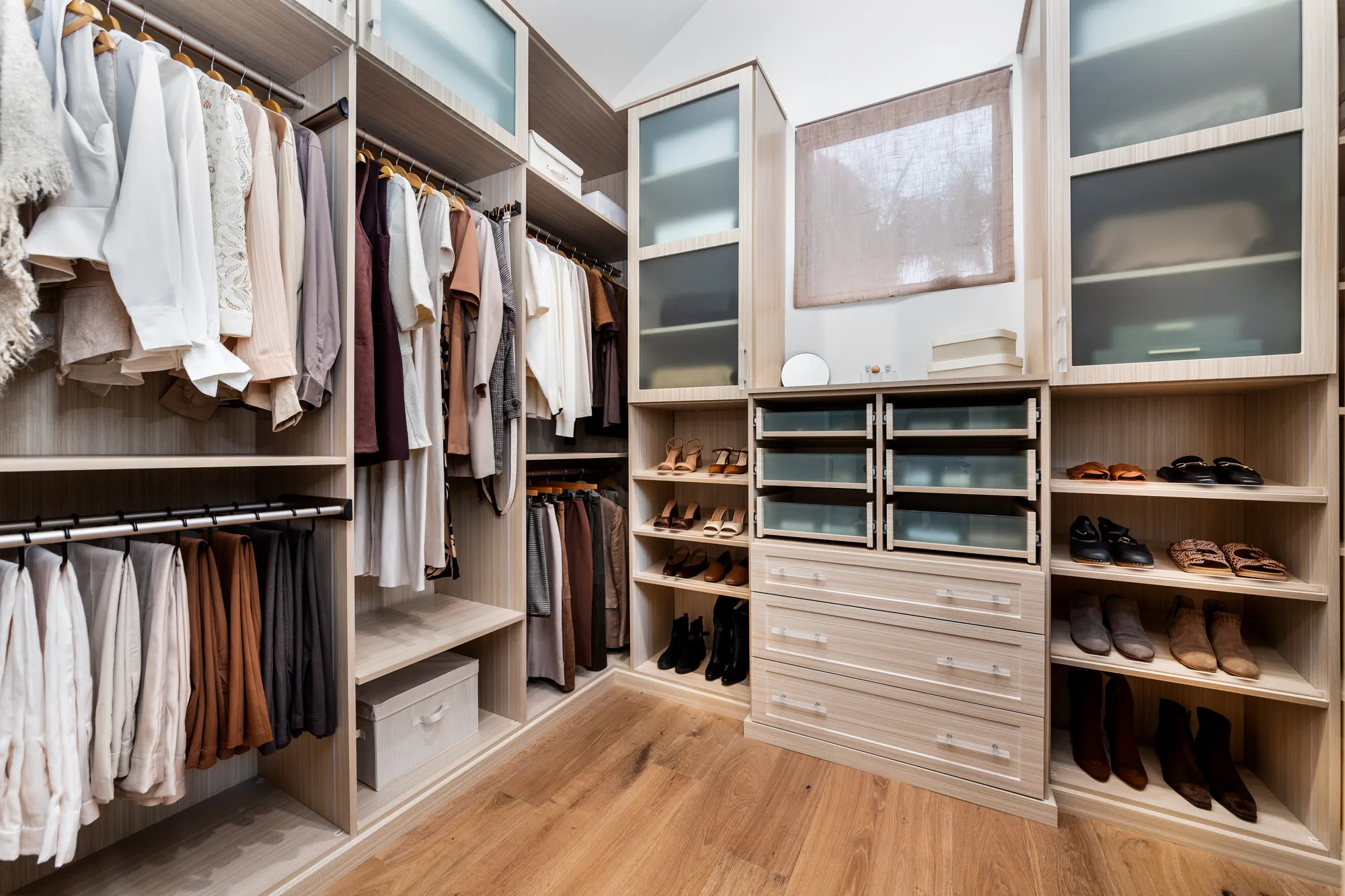
Shoe storage. Best for anyone whose shoes live on the closet floor. Flat shelves spaced 6 to 8 inches apart hold about three pairs per 24-inch shelf. Slanted shelves with a fence show heels and flats at a glance, and hold slightly fewer. A pull-out shoe drawer holds 2 rows at 16 inches deep and up to 4 rows at 24 inches deep, which is a lot of sneakers behind one tidy drawer front. Either way, the floor comes back.
Valet rods. Best for planning an outfit or hanging the dry cleaning for a minute. Our Synergy Valet Rods slide out so you can hang and preview your entire outfit before you even try it on. Retracted, the 12-inch rod tucks into the side of a panel, out of the way. It technically adds zero capacity, and it's still one of the most-used things in any closet that has one.
Belt and tie storage. Best for anyone with more than five belts. A belt drawer in an 8 1/2-inch-wide section holds 16 belts at 16 inches deep and 24 at 24 inches deep, and a tie drawer holds 34 to 50 ties. That's a narrow slice of the closet doing a very specific job well. If you own three belts, a hook does the same thing. If you own twenty, a rack means you'll stop wearing the same two.
Two closet accessories that usually aren't worth it
The title promised a judgment call, so here it is. These two accessories are excellent in the right closet and disappointing in the typical one.
Islands, in walk-ins narrower than about 8 to 10 feet. Our designers plan walk-ins on a 24-inch rule: 24 inches to hang (clothes take up about 22) and 24 inches to walk. A compact island is about 2 feet deep, and it needs that 24-inch walkway on both sides. Add it up, and you need about 8 feet of width with hanging on one wall, or about 10 feet with hanging on both, before the island fits without turning the walk-in into a game of single file. There, the same money and floor buy more as a wall of drawers, which holds just as much and keeps the aisle clear. If you have the room, an island is wonderful, and our guide to walk-in closet islands covers how to set one up. If you're not sure you have the room, you don't.
Built-in hampers, in reach-ins. A tilt-out hamper needs a section at least 18 inches wide, 24 inches tall, and 16 inches deep to hold about one load of laundry. In a reach-in, that same section could be a bank of drawers holding a week of clothes, or double-hang holding about 3 feet of shirts. The laundry still has to make the trip to the washer either way, and a freestanding hamper by the bedroom door works just as well. In a large walk-in with a dressing area, a built-in hamper makes more sense. Size decides it.
Why accessory math is different in California and Las Vegas
In California and Las Vegas, closet space is expensive before any accessory goes in. Redfin's August 2026 data puts the median sale price per square foot at about $621 in Los Angeles and about $250 in Fresno and Las Vegas. A 2-by-6-foot reach-in takes up 12 square feet of floor, which is several thousand dollars of home price just for being there.
That changes the math on accessories. Anything that uses up hanging space or floor, like a hamper, an island, or an oversized shoe tower, is competing with the most valuable thing a closet has. Accessories that use space nothing else can reach (pull-down rods), space nothing else uses (side panels and narrow sections for valet rods and belt storage), or space inside what you already have (drawer inserts) are pure gain. In a market where you can't cheaply add square footage, those are the ones to lead with.
That's how our designers approach every custom closet consultation: they measure the closet, look at what you own, and suggest accessories that pay for the space they take, not a catalog of everything available. For the rod and shelf math behind it, see our guides to vertical storage ideas and closet shelving ideas.
Frequently asked questions
What are the most useful closet accessories?
Pull-down rods, pant racks, drawer inserts, and well-spaced shoe storage are the most useful for most closets, because they add capacity or organize space without taking away hanging room. Valet rods and belt racks are small add-ons that also earn their place.
Is a closet island worth it?
Only in a walk-in that's about 8 feet wide with hanging on one wall, or about 10 feet wide with hanging on both. Our designers allow 24 inches to hang and 24 inches to walk around an island, and in narrower walk-ins, a wall of drawers holds as much without crowding the floor.
Should I put a hamper in my closet?
In a large walk-in with a dressing area, a built-in hamper can work well. In a reach-in, it takes a full section, at least 18 inches wide and 24 inches tall, that usually does more as drawers or hanging space.
What is a valet rod used for?
A valet rod slides out from the side of a closet section so you can hang an outfit, dry cleaning, or tomorrow's clothes for a moment. When it's not in use, it retracts out of the way.
Choose accessories that give back more than they take
The best closet accessories aren't the most impressive ones. They're the ones that add capacity or save you a step every day, without taking away the space that makes a closet work. Start with the rods and shelves, add the accessories that use space nothing else can, and skip anything that's mostly there to look good on day one.
We've been designing and installing custom closets in California and Las Vegas since 1991, with every system built in our own factory. Book your FREE in-home design consultation, and our designer will help you pick the accessories that make sense for your closet, and talk you out of the ones that don't.