










Key takeaways
- Choose the bed by what the room must do when no one is sleeping in it: a wall bed for a daily office, a loft bed for a desk underneath, a trundle or daybed for occasional guests.
- A Murphy bed, also called a wall bed, folds into a wall-mounted cabinet so the floor is clear by day. Closet World's BedTec system needs about 16 inches of depth when closed.
- If the room doesn't need to disappear as a bedroom, moving clothes into a well-designed closet and dropping the dresser can free more floor space than a different bed.
- Measure before you buy: every space-saving bed has one dimension, such as ceiling height or wall depth, that decides whether it fits.
Originally published February 9, 2024 · Updated October 2026
A space-saving bed is any bed that gives floor space back when you are not sleeping in it or stores things you would otherwise need furniture for. The main types are wall beds (Murphy beds), loft beds, trundle beds, daybeds, storage beds and sofa beds. The best one depends on whether the room is slept in nightly, the ceiling height, and what else the room has to do.
Key Takeaways
- Choose the bed by what the room must do when no one is sleeping in it: a wall bed for a daily office, a loft bed for a desk underneath, a trundle or daybed for occasional guests.
- A Murphy bed, also called a wall bed, folds into a wall-mounted cabinet so the floor is clear by day. Closet World's BedTec system needs about 16 inches of depth when closed.
- If the room doesn't need to disappear as a bedroom, moving clothes into a well-designed closet and dropping the dresser can free more floor space than a different bed.
- Measure before you buy: every space-saving bed has one dimension, such as ceiling height or wall depth, that decides whether it fits.
What is the best space-saving bed for a small room?
The best space-saving bed for a small room is the one that disappears or works hardest during the hours you are not asleep. For a room that doubles as an office, a wall bed clears the floor completely. For a child's room with a high ceiling, a loft bed puts a desk underneath. For an occasional guest room, a trundle or daybed adds a second sleeping spot. For a bedroom short on closet space, a storage bed replaces a dresser.
Small-space living often means one room has to do two jobs. A bedroom may double as a home office, a guest room may become a workspace, and an ADU may need to function as an entire living area. That's why the best space-saving bed isn't necessarily the smallest bed; it's the one that gives the room its other function back.
Space-Saving Bed Options Compared
Six bed types solve the small-room problem differently.
| Bed type | Best for | Floor space when not in use | Who it suits |
|---|---|---|---|
| Wall bed (Murphy bed) | Rooms that double as an office | Fully cleared; folds into a cabinet | Adults who need the room by day |
| Loft bed | High ceilings; desk beneath | Floor beneath the bed is free | Children, teenagers, students |
| Trundle bed | An occasional second sleeper | Slides under the main bed | Kids' rooms, guest rooms |
| Daybed | Sitting room by day | Doubles as a sofa | Guest rooms, home offices |
| Storage bed | Bedrooms short on closet space | Unchanged; replaces a dresser | Primary bedrooms, apartments |
| Sofa bed | Living rooms that host guests | Folds into a sofa | Studios, infrequent guests |
Loft beds
A loft bed raises the mattress high enough to put a desk, dresser or seating underneath, which doubles the usable floor area of its footprint. It needs enough ceiling height to sit up in bed and to stand comfortably below.
Foldable and Murphy beds
A foldable bed or Murphy bed stores vertically when not in use. A basic folding bed collapses into a closet; a Murphy bed, also called a wall bed, mounts to the wall and folds into a cabinet, so the floor is clear by day. Wall beds are the strongest option when the room has a second purpose.
Under-bed storage and storage beds
Under-bed storage uses the space beneath the mattress. A platform bed with drawers, a lift-up storage bed, or rolling bins under a raised frame hold bedding, off-season clothing and shoes, replacing a dresser in a room that cannot fit one.
Custom frames for niche spaces
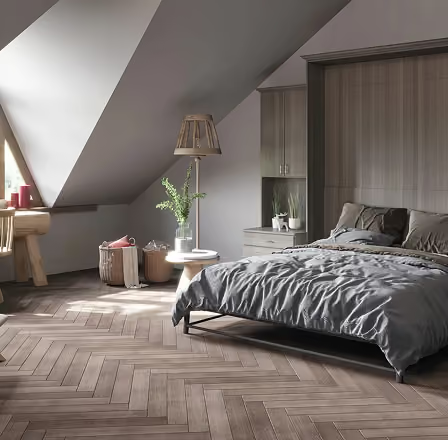
An alcove, a dormer or a corner under a sloped ceiling often cannot take a standard frame. A custom frame built to the niche turns dead space into the bed's home. Awkward corners cause the same problem in closets; see these corner closet ideas.
Trundle beds
A trundle is a second mattress on a low frame that slides beneath the main bed and pulls out when needed, the simplest way to sleep two in a room sized for one.
Daybeds and sofa beds
A daybed is a twin-sized bed with a back and sides that reads as a sofa by day. A sofa bed is a sofa with a fold-out mattress. Both let a living room or office host overnight guests.
Which space-saving bed should you choose?
Start with what the room has to do when no one is sleeping in it, then match the bed to that job:
- Need the room as an office every day? A Murphy bed (wall bed) folds away and clears the floor.
- Need a desk underneath the bed? A loft bed, if the ceiling is high enough to sit up in bed and stand below.
- Need a second bed only occasionally? A trundle bed slides out when a guest arrives.
- Need the bed to work as seating? A daybed reads as a sofa during the day.
- Need more clothing storage? A storage bed, a closet redesign, or both.
- Need occasional guest sleeping in a living space? A sofa bed.
The Murphy Bed Option: What to Know About a Wall Bed
A Murphy bed, also called a wall bed, is the right space-saving bed when the room must be fully usable for something else every day. The bed folds up into a wall-mounted cabinet, so the floor is clear when it is closed, and the cabinet can be planned with shelving and storage around it so the wall does more than hide a bed.
Closet World's BedTec wall bed system is one example. The facts to know before planning one, as described on Closet World's Murphy bed page:
- BedTec needs about 16 inches of depth from the wall to the back of the cabinet doors when closed.
- Closet World describes BedTec as using a spring-loaded mechanism designed to reduce the wall footprint, with a powder-coated steel frame.
- Closet World Murphy beds are designed for regular use, not only for guests.
- Built-in shelving, nightstands, cabinets, drawers and lighting are optional additions.
- Combined with a custom home office, a BedTec bed lets the office double as a guest room; see the office and wall bed combination page and these Murphy bed home office and guest room ideas.
A wall bed is the wrong answer for a room that is only a bedroom. There, the floor space has to come from somewhere else.
When is a closet the better space-saving solution?
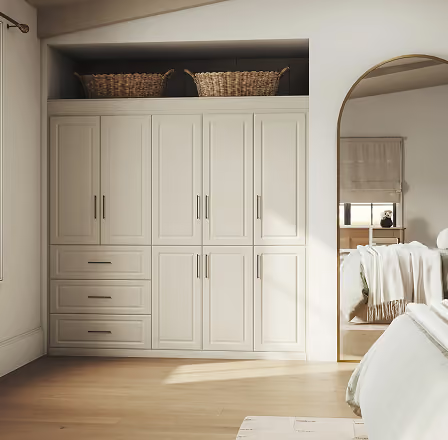
If the room doesn't need to disappear as a bedroom, the better space-saving move may be to eliminate the dresser instead. In a small bedroom, freestanding storage such as a dresser, a wardrobe or a tall chest takes floor space the room can't spare, and none of it uses the wall height a closet already has.
A redesigned reach-in closet can take over that job with double hanging, built-in drawers and shelving, so the dresser can go and its floor space goes back to the room. A storage bed does a smaller version of the same thing, holding bedding and off-season clothing under the mattress. The two work together: the closet handles hanging clothes and everyday folded pieces, and the bed handles what you reach for least.
Choose a wall bed when the room needs its floor back for another use. Choose a closet redesign, a storage bed or both when the room is a bedroom that simply holds too much furniture.
Assess Your Room Layout and Flow
Start by mapping how you move through the room: door to closet, to window, to desk. A bed that blocks any of those paths makes the room feel smaller than it is. Note the fixed elements you cannot move, such as the door swing and closet doors, and decide what the room must do besides sleeping. A room that is also an office needs the bed to surrender its wall by day.
Where Should I Put My Bed in a Small Room?
Put the bed against the longest uninterrupted wall, away from the door swing and closet doors, with at least one side open. In most small rooms that means the wall opposite or beside the door rather than the window wall. If the room is narrow, placing the bed lengthwise along one wall, daybed style, leaves a clear corridor.
Measure Before You Buy
Every space-saving bed has a dimension that trips people up. Check these first:
| Bed type | What to measure | Why it matters |
|---|---|---|
| Loft bed | Ceiling height above the mattress and headroom beneath it | You need to sit up in bed without touching the ceiling and stand comfortably below |
| Wall bed (Murphy bed) | The floor the open bed covers plus room to walk around it, and the wall depth when closed (about 16 inches for BedTec) | The room has to work with the bed both open and closed |
| Trundle bed | Clear floor on the side the trundle slides toward | The second mattress needs room to pull fully out |
| Storage bed | Drawer extension on each side that has drawers | A drawer against a wall or another piece of furniture cannot open |
| Daybed or sofa bed | The footprint when converted for sleeping | A fold-out mattress can block a door, closet or walkway |
| Any bed | Door and closet swing arcs, and window placement | No bed, open or closed, should sit inside a door arc or cover the window |
More Tips for Maximizing a Small Bedroom
Two other decisions make a small room feel larger.
Choose multifunctional furniture
Every piece should do two jobs. A nightstand with drawers replaces a dresser, and a bench at the foot of the bed stores bedding. Built-in shelving around a wall bed uses wall height that freestanding furniture leaves empty.
Use light and color
Pale walls, a light bed frame and cabinetry in a single finish make the room read as one space. A mirror opposite a window reflects daylight into the room, and integrated lighting lifts dark corners.
Frequently asked questions
What is a space-saving bed?
A bed that frees floor space when not in use or stores belongings you would otherwise need furniture for. Wall beds, loft beds, trundles, daybeds, storage beds and sofa beds all qualify.
Is a Murphy bed good for a small room?
Yes, when the room has a second daytime use such as an office. The bed folds into a cabinet and the floor is clear. Closet World's BedTec system needs about 16 inches of depth when closed.
What is the difference between a Murphy bed and a wall bed?
There is none. Murphy bed is the common name, taken from its inventor, and wall bed describes how it works: the bed folds up into a cabinet mounted against the wall.
What is the difference between a loft bed and a bunk bed?
A loft bed has one mattress raised high with open space below for a desk or storage. A bunk bed has two mattresses stacked. Loft beds suit one sleeper who needs floor space; bunks suit two.
Where should a bed go in a small bedroom?
Against the longest uninterrupted wall, clear of the door swing and closet doors, with at least one side open. Avoid the window wall if another is available.
Can a small bedroom have a double or queen bed?
Often, if the rest of the furniture is reduced. Moving clothing into a well-designed closet, choosing a storage bed instead of a dresser, and using wall-mounted lighting instead of nightstands free the floor a larger mattress needs.
Ready to organize your bedroom? Get a free in-home design consultation.
A Closet World designer can measure the room and plan a wall bed, built-ins or a closet redesign around how you use it. Schedule a free in-home design consultation.
Frequently asked questions
What is a space-saving bed?
A bed that frees floor space when not in use or stores belongings you would otherwise need furniture for. Wall beds, loft beds, trundles, daybeds, storage beds and sofa beds all qualify.
Is a Murphy bed good for a small room?
Yes, when the room has a second daytime use such as an office. The bed folds into a cabinet and the floor is clear. Closet World's BedTec system needs about 16 inches of depth when closed.
What is the difference between a Murphy bed and a wall bed?
There is none. Murphy bed is the common name, taken from its inventor, and wall bed describes how it works: the bed folds up into a cabinet mounted against the wall.
What is the difference between a loft bed and a bunk bed?
A loft bed has one mattress raised high with open space below for a desk or storage. A bunk bed has two mattresses stacked. Loft beds suit one sleeper who needs floor space; bunks suit two.
Where should a bed go in a small bedroom?
Against the longest uninterrupted wall, clear of the door swing and closet doors, with at least one side open. Avoid the window wall if another is available.
Can a small bedroom have a double or queen bed?
Often, if the rest of the furniture is reduced. Moving clothing into a well-designed closet, choosing a storage bed instead of a dresser, and using wall-mounted lighting instead of nightstands free the floor a larger mattress needs.

CW Man’s two cents
Let’s plan the room you actually have
Your designer plans around your space, your things and your routine. Free in-home or virtual design consultation, in as little as 90 minutes.