










Key takeaways
- New England builds basements; the Pacific states and Texas build slabs.
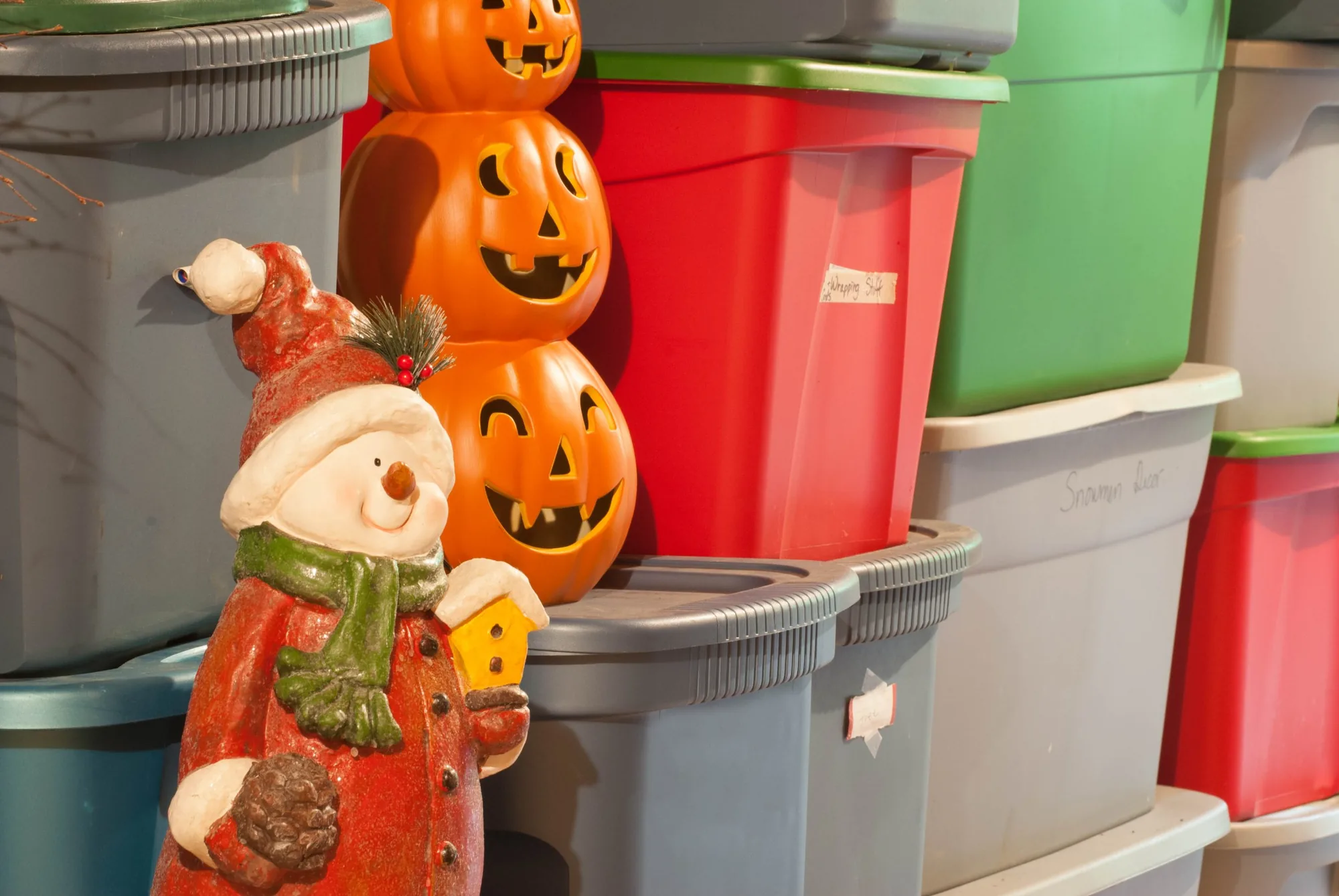
- Garage heat can damage candles, batteries, adhesives, paper and clothing.
- Rent the folding tables and chairs that come out once a year.
- A one-meal household's once-a-year gear takes about 18 cubic feet.
- Heavy pans and chairs go low; linens and paper stay indoors.
Which regions have basements, and which rely on the garage?
In 2024, 73% of new single-family homes started in the United States were built on slab foundations and only 17% had a full or partial basement, according to the National Association of Home Builders' analysis of the Census Bureau's Survey of Construction. Basements are a northern feature: 67.2% of new homes in New England and 62.3% in the West North Central states have one, versus about 10% on the West Coast.
| Census division | New homes on slabs, 2024 | New homes with full or partial basement, 2024 |
|---|---|---|
| West South Central (TX, OK, AR, LA) | 97.9% | Below 10% |
| Pacific (CA, OR, WA, AK, HI) | 89.9% | About 10% |
| South Atlantic | 85.7% | Not reported |
| Middle Atlantic | Not reported | 48.8% |
| East North Central | Not reported | 50.3% |
| West North Central | Not reported | 62.3% |
| New England | Not reported | 67.2% |
Source: NAHB Eye on Housing, Survey of Construction, 2024 single-family starts.
Garages fill the gap. According to the Department of Energy's summary of the American Housing Survey, 76% of occupied homes in the West and 72% in the Midwest have a garage or carport, compared with 56% in the South and 49% in the Northeast. For a slab-foundation household, that garage is attic, basement and utility room at once.
How hot does a garage get, and what does the heat ruin?
Las Vegas's normal daily high in July is 104.5 F, and the city hit 120 F on July 7, 2024, according to the National Weather Service. An uninsulated garage can get hotter than the air outside. That is the condition a stored box has to survive, and some categories do not.
| Fails in a hot, unconditioned garage | Holds up |
|---|---|
| Candles and anything wax-based (softens and warps) | Folding tables and chairs, metal or resin |
| Batteries, including power-tool packs, which lose charge, swell or become a fire risk in heat | Roasting pans, sheet pans and metal serving pieces |
| Adhesives, caulk, paint and many cleaners, which separate or break down | Glass and ceramic serving pieces, packed upright |
| Photos, paper records, books and cardboard boxes, which absorb moisture and soften | Coolers, camping gear, sports equipment |
| Clothing and linens, exposed to pests and mold | Sealed plastic bins of textiles, if the bins stay off the floor |
| Canned food and wine | Tools, hardware, and sealed hard plastics |
"Clothing is susceptible to mold and damage from pests," Katherine Lawrence, a professional organizer and founder of Space Matters, told SpareFoot, which also notes that cardboard absorbs moisture and softens. As for batteries, a DeWalt product manager told Bob Vila that power-tool batteries should not be stored in a hot or humid garage. Keep those indoors, in a closet or cabinet, and let the garage hold what heat cannot hurt.
Should you keep it, rent it or borrow it?
Before measuring a shelf for something, decide whether it has earned the space. A workable rule:
- Keep it if you use it at least twice a year, if it is sentimental, or if no rental version exists. The roasting pan, the good platters and the electric griddle stay.
- Rent it if it comes out once a year and takes up more than a bin's worth of space. Folding tables, stacks of chairs, a coat rack for 20 guests and a chafing-dish setup are all rental-counter items.
- Borrow it if it is small, specialized and owned by someone within a 10-minute drive: a second slow cooker, a punch bowl, a card table.
Cara Palmer, a professional organizer and the owner of Organize Every Room, told Homes & Gardens to ask, "Could I borrow or rent this instead?" She called the question "particularly powerful for items you'll use infrequently."
How much space do once-a-year items take?
Measure them the way a mover would: length by width by height, in inches, then divide by 1,728 to get cubic feet. A typical tally for a household that hosts one big meal a year looks like this.
| Item | Packed size (inches) | Cubic feet |
|---|---|---|
| Roasting pan with rack | 18 x 13 x 9 | 1.2 |
| Six-foot folding table, folded | 72 x 30 x 3 | 3.8 |
| Four folding chairs, stacked | 36 x 18 x 8 | 3.0 |
| Serving platters and bowls, one bin | 24 x 16 x 12 | 2.7 |
| Tablecloths, napkins, extra flatware, one bin | 24 x 16 x 12 | 2.7 |
| Large cooler | 28 x 16 x 17 | 4.4 |
| Total | About 18 cubic feet |
Eighteen cubic feet is roughly equivalent to a stack roughly 2 feet deep, 3 feet wide and 3 feet tall: one section of a garage shelving unit, or the top shelf and floor of a hall closet. Written down, it is a manageable number. Spread across a kitchen, a hall closet and the garage floor, it reads as clutter in three rooms.
Where should it live?
Put the heavy pieces low and the heat-sensitive pieces inside. "Storing infrequently used platters and serving dishes in upper cabinets frees up space in lower cabinets for often-used kitchen items," Julie Peak, a professional organizer and owner of The Precise Place, told Livingetc. Roasting pans and stacked chairs belong on a low shelf or the floor of a garage rack, where they're easier and safer to lift. Tables and coolers can hang on wall hooks. Linens and paper go in a sealed bin in a closet, not the garage. Label every bin on both sides, and store the bins where the host can reach them without a ladder.
This story was produced by Closet World and reviewed and distributed by Stacker.
Frequently asked questions

CW Man’s two cents
Let’s plan the room you actually have
Your designer plans around your space, your things and your routine. Free in-home or virtual design consultation, in as little as 90 minutes.


