








Key takeaways
- Match the storage to the child's height and the size of the pieces, not to the look of the room.
- Open bins for toddlers, labeled shelves for preschoolers, shallow drawers for small pieces from about age five.
- Any piece small enough to fit through a toilet paper tube is a choking hazard for children under 3. Keep those sets in separate, higher storage.
- Toys live where kids play. In many California and Las Vegas homes, with no basement and no spare room, that means the living room and the kid's bedroom closet.
- Adjustable shelving is the single feature that makes toy storage last.
The best toy storage and organization ideas are the ones built around how a child changes. A toddler needs open bins at floor level with a few toys in each. A six-year-old needs shelves for building sets and a place to keep a project out overnight. A ten-year-old needs drawers for small pieces and room for the things that are no longer toys. Storage built for one of those stages stops fitting as the child grows. The most efficient storage plans are the ones that adjust: shelves that move, bins that swap and a kid's closet system that can adapt. Let's look at toy storage by age. What can kids reach? How do you store LEGO and other small pieces to prevent the dreaded stepping on a LEGO piece in the middle of the night? How can you keep storage safe?
How should toy storage change by age?
| Age | What they play with | Storage that works | What to avoid |
|---|---|---|---|
| Under 3 | Large pieces, soft toys, push and pull toys, board books | A few open bins at floor level, one type per bin. Low shelf for books, covers facing out. | Lids, small bins, anything above their reach, too many toys out at once, any piece small enough to fit through a toilet paper tube |
| 3 to 5 | Pretend play sets, puzzles, building blocks, art supplies | Labeled bins with a picture label, cubbies at eye level, a low table with storage underneath | Deep bins where pieces get lost, mixed-category bins |
| 5 to 8 | Building sets with small pieces, games, collections, craft projects | Shallow drawers or divided trays for small pieces, a shelf for a project in progress, closed storage for games | Open bins for small pieces, storage so high an adult has to get things down |
| 8 to 12 | Hobby gear, books, electronics, sports equipment, fewer toys | Drawers, a desk surface, hooks for gear, shelves that convert to books and display | Storage that still looks like a nursery |
The pattern across every age is fewer toys out at once. A rotation box of toys stored out of sight, swapped every few weeks, keeps interest high and the floor clear, and it works at every stage.
What toy storage can kids actually reach?
A toy a child cannot reach is a toy a parent puts away. Plan the zones around the child's height, and move them up as the child grows.
| Zone | Height | What goes there |
|---|---|---|
| Floor to about 24 in. | Toddler reach | Open bins, the current favorites, board books |
| 24 to 40 in. | Preschool to early elementary reach | Labeled bins, cubbies, the toys they clean up themselves |
| 40 to 54 in. | Older kids | Drawers, books, projects, hobby storage |
| Above 54 in. | Adults | Rotation box, outgrown toys waiting to be passed on, anything with small parts for younger siblings |
Anything the child is expected to put away belongs in the zone they can reach without climbing. Adjustable shelves let the same closet shift those zones upward every year or two instead of being rebuilt. The heights are approximate bands for comfortable reach, below a child's standing height. For reference, the CDC growth chart data put the 50th percentile standing height at about 34 inches at age 2, 43 at age 5, 50 at age 8 and 55 at age 10.
Bins, shelves or cubbies: which is right?
Each one suits a different kind of toy, and most rooms need all three.
- Bins hold things that are grabbed by the handful: blocks, cars, soft toys, dress-up clothes. Keep them shallow enough that a child can see the bottom, and limit each to one category. A bin with a picture label works before a child can read.
- Shelves hold things that are chosen one at a time: books, puzzles, games, display pieces, a half-built model. Shelves 10 to 12 inches deep fit most of these without items disappearing at the back.
- Cubbies are shelves with walls, which keeps categories from spreading into each other. A cubby unit at a child's height is the most self-explanatory storage there is: one space, one kind of toy.
How do you store LEGO and other building sets?
Building sets need three things: a sorting system the child can follow, shallow storage so every piece is visible, and a place to leave a build in progress.
- Sort the way the child builds. Younger builders do best with color sorting. Children who build from instructions do better keeping each set in its own bag or box with its instructions. Mixed collections work in drawers sorted by piece type.
- Use shallow drawers with dividers. Drawers 2 to 4 inches deep with removable dividers keep every piece visible. Deeper drawers bury the pieces at the bottom.
- Give builds a tray. A flat tray or board that slides onto a shelf keeps a build in progress intact between sessions and lets a child put it away without taking it apart.
- Keep a catch bin. One labeled bin collects loose pieces found on the floor. Sort them back into the drawers once a week.
- Store large flat pieces separately. Baseplates and large panels stand upright in a slot or lie flat on a top shelf.
- Keep small-piece sets away from children under 3. Store them in the high zone, and use large-format bricks for younger siblings.
Living room toy storage ideas for homes without a playroom
Many homes in California and Las Vegas don't have a basement or a spare room, so toys live in the rooms the family uses. That is workable if each room has a defined toy zone.
Living room. Closed storage that reads as furniture: a cabinet with bins inside, a bench with lift-up storage, or a low console with doors. The rule is that the room can be reset in five minutes. Keep the living room set small: a rotation of favorites, not the full collection.
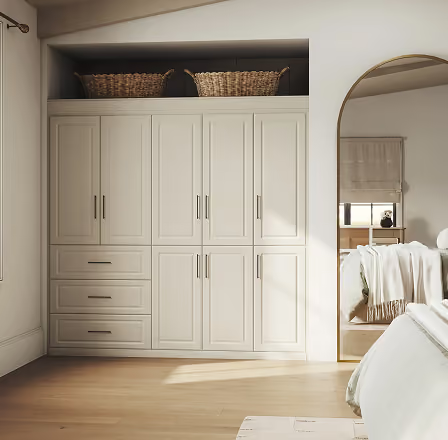
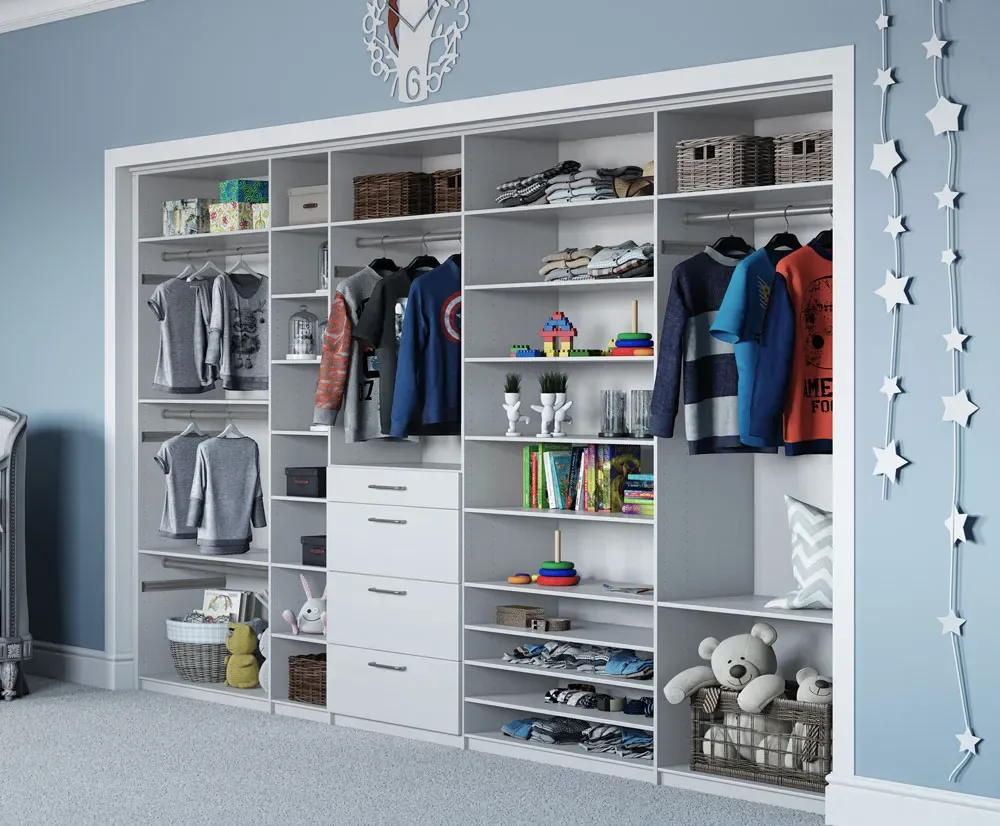
Bedroom. The bedroom closet is the largest storage volume in a child's room and is usually the least used. A single rod and a shelf wastes most of it. Reworked with low shelves, drawers and a short hanging section, the closet takes most of the toys off the floor and out of sight.
Garage. Outdoor toys, ride-ons and sports gear belong in the garage on hooks and low shelves, not in the house. In inland California and Las Vegas, the garage gets hot in summer, so anything plastic that could warp, or anything with batteries, stays inside.
How do you keep toy storage safe?
- Anchor tall pieces. Bookcases, cubby units and dressers should be fastened to wall studs so they cannot tip when a child climbs them. CPSC's Anchor It! campaign recommends anchoring bookcases and dressers securely to the wall.
- Skip heavy lids. Open bins, or bins with light lids that cannot drop on fingers, suit young children.
- Separate small parts. Anything small enough to fit through a toilet paper tube stays out of reach of children under 3. The tube is a common home check, and CPSC's small parts rules cover toys made for children under 3, so pieces from older children's sets are the ones to keep separate.
- Check the reach zones every year. A shelf that was safe at floor level for a toddler may need to move up as the child grows.
How does a kids' closet adapt as they grow?
A child's closet built with adjustable components handles every stage above without being rebuilt. The pieces that matter:
- Adjustable shelves that move up as the reach zones move up.
- A rod that raises, from toddler height to adult height, so hanging clothes stay reachable.
- Drawers that hold small pieces now and clothing later.
- Bins on shelves instead of fixed cubbies, so the categories change without the closet changing.
- A tall section left open for the rotation box, then for sports gear, then for whatever comes next.
Closet World designs kids' closets this way: built to the room, with shelves, rods and drawers that adjust as your child grows, in finishes that work in a nursery and still work in a teenager's room. Designed for you, in your home, and installed by Closet World's own team. For rod and shelf heights by age, see our guide to how to organize your kid's closet by age.
Let's get the kids' room organized
Schedule your free, in-home design consultation. A Closet World designer measures the closet and plans storage that fits your child now and adjusts as they grow.
Frequently asked questions
What is the best toy storage for small spaces?
Use the closet. Rework it with low shelves, drawers and bins so most toys live there, and keep a small rotation of favorites in the room. Closed storage that reads as furniture handles the rest.
What is the best storage for LEGO?
Shallow drawers, 2 to 4 inches deep, with dividers, sorted by color or piece type, plus a slide-out tray for a build in progress. Open bins don't work for small pieces.
How do you make toy storage kids can use?
Put everything they are expected to put away within their reach, one category per bin or cubby, with a picture label until they can read. Adults keep the overflow and the rotation box up high.
How many toys should be out at once?
Fewer than you think. A small rotation, swapped every few weeks, keeps play focused and clean-up short. Store the rest out of sight.

CW Man’s two cents
Let’s plan the room you actually have
Your designer plans around your space, your things and your routine. Free in-home or virtual design consultation, in as little as 90 minutes.