













Key takeaways
- Older adults outnumber children in 11 states and 1,411 counties.
- 43% of adults 50 and older expect to need accessibility changes at home.
- Fewer than 1% of single-family homes are fully wheelchair accessible.
- Treat the holiday visit as an inspection of reaches, bends and stairs.
- Move daily-use and heavy items between hip and shoulder height first.
We looked at the county data and the aging-in-place research to identify what to change before next year's visit, starting with what sits above shoulder height.
Where is the population aging fastest?
| Measure | 2020 | 2024 |
|---|---|---|
| Share of U.S. population 65 and older | 16.8% (2020 Census) | 18.0% |
| Counties where older adults outnumber children | 983 (31.3%) | 1,411 (nearly 45%) |
| States where older adults outnumber children | 3 (Maine, Vermont, Florida) | 11 |
| Metro areas where older adults outnumber children | 58 | 112 |
| Population 65 and older | About 54 million | 61.2 million |
Source: U.S. Census Bureau, Vintage 2024 Population Estimates, June 26, 2025. The 2020 share and count are from the 2020 Census as reported by the bureau.
"The number of states and counties where older adults outnumber children is on the rise, especially in sparsely populated areas," Lauren Bowers, chief of the bureau's Population Estimates Branch, said in the release. The extreme case is Sumter County, Fla., where 57.2 percent of residents were 65 or older in 2024 and 7.4 percent were children, according to USAFacts.
How many people plan to stay in their homes?
Most of them. AARP's 2024 Home and Community Preferences Survey found that 75 percent of adults 50 and older want to remain in their current home as they age and 73 percent want to stay in their community. Even so, 44 percent expect to move at some point, and 43 percent say they will need to make the house more accessible, with bathroom changes at the top of the list. "As people age, affordable and independent living isn't just a preference, it's essential for their wellbeing," Rodney Harrell, AARP's vice president of family, home and community, said in the release. Deb Whitman, AARP's chief policy officer, told HomeCare that fewer than 1 percent of single-family homes are fully wheelchair accessible.
Many of those homes are already shared. About 18 percent of the U.S. population lived in a multigenerational household in 2021, defined as two or more adult generations under one roof, up from 7 percent in 1971, according to the Pew Research Center. The Thanksgiving table is a preview of that arrangement for everyone else.
What does the holiday visit reveal about the house?
The signs are small and specific. A parent avoids the stairs after the first night. The everyday glasses are on the third shelf and the step stool has moved to the kitchen permanently. The guest room is where the holiday bins, the exercise bike and three years of paperwork went, so the guest sleeps on the couch. None of it is a crisis; all of it is information. The useful response is to treat the visit as an inspection and write down what someone reached for, bent for or avoided.
Which storage changes keep a home working as the people in it age?
Start with reach, because it is the cheapest fix. The federal accessibility standard for a forward reach from a wheelchair runs from 15 to 48 inches above the floor, according to the U.S. Access Board; for a standing adult with reduced balance or shoulder range, the comfortable band is narrower, roughly hip to shoulder. The changes, in order:
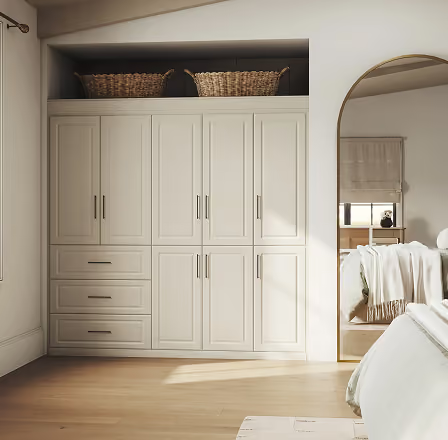
- Move below shoulder height first: anything heavy, anything used daily, and anything breakable. Dinner plates, the coffee setup, the pots, daily medication and the clothes worn most.
- Bring the closet rod down or add a second rod at a lower height, so hanging clothes are reachable without a stretch. Pull-down rods bring an upper rod to hand height.
- Replace deep fixed shelves with drawers and pull-out trays wherever the back of the shelf is where things go to be forgotten.
- Put rarely used, lightweight items on the high shelves that remain: seasonal linens, empty luggage, the wrapping paper.
- Clear the floor of the closet and the path to it, so a walker or a wheelchair turns without catching a basket.
- Light the inside of closets and cabinets. Reaching for something you cannot see is how shoulders and wrists get hurt.
The guest room comes last, and it is the easiest: once the storage that migrated there has a lower, reachable home elsewhere, it is a bedroom again. That is the room the visiting parent will need first, and on the ground floor if the house has one.
This story was produced by Closet World and reviewed and distributed by Stacker.
Frequently asked questions

CW Man’s two cents
Let’s plan the room you actually have
Your designer plans around your space, your things and your routine. Free in-home or virtual design consultation, in as little as 90 minutes.