









Key takeaways
- Uninsulated garages commonly run 10 to 30 degrees hotter than the air outside, which can push an inland garage past 110 to 130 degrees.
- In dry inland climates, heat is a bigger threat to cabinets than humidity. Resin warps in it, and edges and finishes need to handle both.
- Our garage cabinets come 12 to 28 inches deep. Plan about 3 feet of walkway between the cabinets and the car's bumper.
- Aerosols, paint, lithium-ion batteries, medications, and wine all have heat limits a Western garage routinely beats.
- Tall cabinets belong secured to wall studs. That's Cal OES and FEMA earthquake guidance, not just good manners.
Originally published February 13, 2024 · Updated September 2026
The best garage storage cabinets for California and Las Vegas are built for heat as well as weight. Uninsulated garages commonly run 10 to 30 degrees hotter than the air outside, so inland garages can pass 110 degrees in summer. Choose materials that stay stable in dry heat, with sealed, banded edges. Size cabinets so the car still fits, secure tall cabinets to wall studs, and store heat-sensitive items indoors.
Key Takeaways
- Uninsulated garages commonly run 10 to 30 degrees hotter than the air outside, which can push an inland garage past 110 to 130 degrees.
- In dry inland climates, heat is a bigger threat to cabinets than humidity. Resin warps in it, and edges and finishes need to handle both.
- Our garage cabinets come 12 to 28 inches deep. Plan about 3 feet of walkway between the cabinets and the car's bumper.
- Aerosols, paint, lithium-ion batteries, medications, and wine all have heat limits a Western garage routinely beats.
- Tall cabinets belong secured to wall studs. That's Cal OES and FEMA earthquake guidance, not just good manners.
In August, the can of spray paint in your garage is having a worse summer than you are. So is the leftover latex paint, the cordless drill battery, and the case of wine someone set out there "just for now" in April. In Fresno or Las Vegas, the garage is the hottest room in the house, and it's also the one holding the most random stuff. The right cabinets can handle the heat. The trick is knowing which of your things can, too.
How hot does a garage get in California and Las Vegas?
Hotter than the forecast. The National Weather Service's normal July high in Fresno is 97.7 degrees, and Las Vegas hit an all-time record of 120 degrees in July 2024. A garage doesn't get air conditioning, and its door and roof soak up sun all afternoon. Garage-cooling guides put an uninsulated garage at about 10 to 18 degrees above the outdoor temperature on a sunny day. In desert climates, 15 to 30 degrees hotter is common, which means 110 to 130 degrees inside from June through September.
Most national garage advice is written for places where the garage's big problem is winter damp. Here it's heat, and that changes which cabinets last and what belongs inside them. It changes the humidity picture, too. Inland California and Las Vegas are dry, so the classic "cabinets swell in a damp garage" warning matters less than it does back east. The exceptions are coastal homes and any cabinet near the garage door, where rain and driveway runoff find their way in.
Which garage cabinet material holds up best in heat?
Each common material handles heat, moisture, and weight differently. Here's how they compare.
| Material | Heat tolerance | Humidity behavior | Load | Relative cost | The trade-off |
|---|---|---|---|---|---|
| Resin or plastic | Low. Softens and warps in sustained heat and direct sun. | Excellent. Won't rust or swell. | Light. Shelves bow under paint cans and toolboxes. | $ | Easy to buy and easy to replace, which is good, because you may need to. |
| Melamine (laminate over particle board) | Good. The laminate shrugs off dry heat. | Fair. Sealed faces resist moisture, but a raw or chipped edge can swell if it sits in a puddle. | Good, as long as shelf spans stay short. | $$ | Lives or dies by its edge banding and whether it's kept off a wet floor. |
| Plywood | Good. Stable in dry heat. | Fair to good once sealed. Unsealed plywood can delaminate over time. | Very good. Stiffer than particle board at the same thickness. | $$-$$$ | Needs a finish, and it's heavy to hang. |
| Powder-coated steel | Excellent. Won't warp or swell. | Good inland. It can rust where the coating chips, especially near the coast. | Very good. | $$-$$$ | Gets hot to the touch in sun, and dents the first time a bike handlebar swings into it. |
Two things decide real-world performance more than the material's name. One is the edges. The weak point of any engineered-wood cabinet is its edges, so fully banded edges and doors that close tight matter more than what's in the core. The other is the shelf span. Every material sags more as a shelf gets longer, which is why our designers keep shelves at 42 inches or less between supports, and 26 inches or less for heavy loads. The same span rules apply inside the house, as our guide to closet shelving ideas explains.
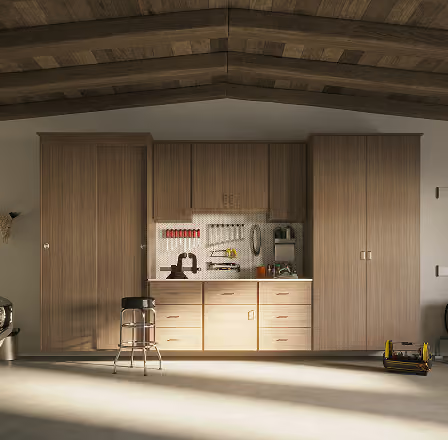
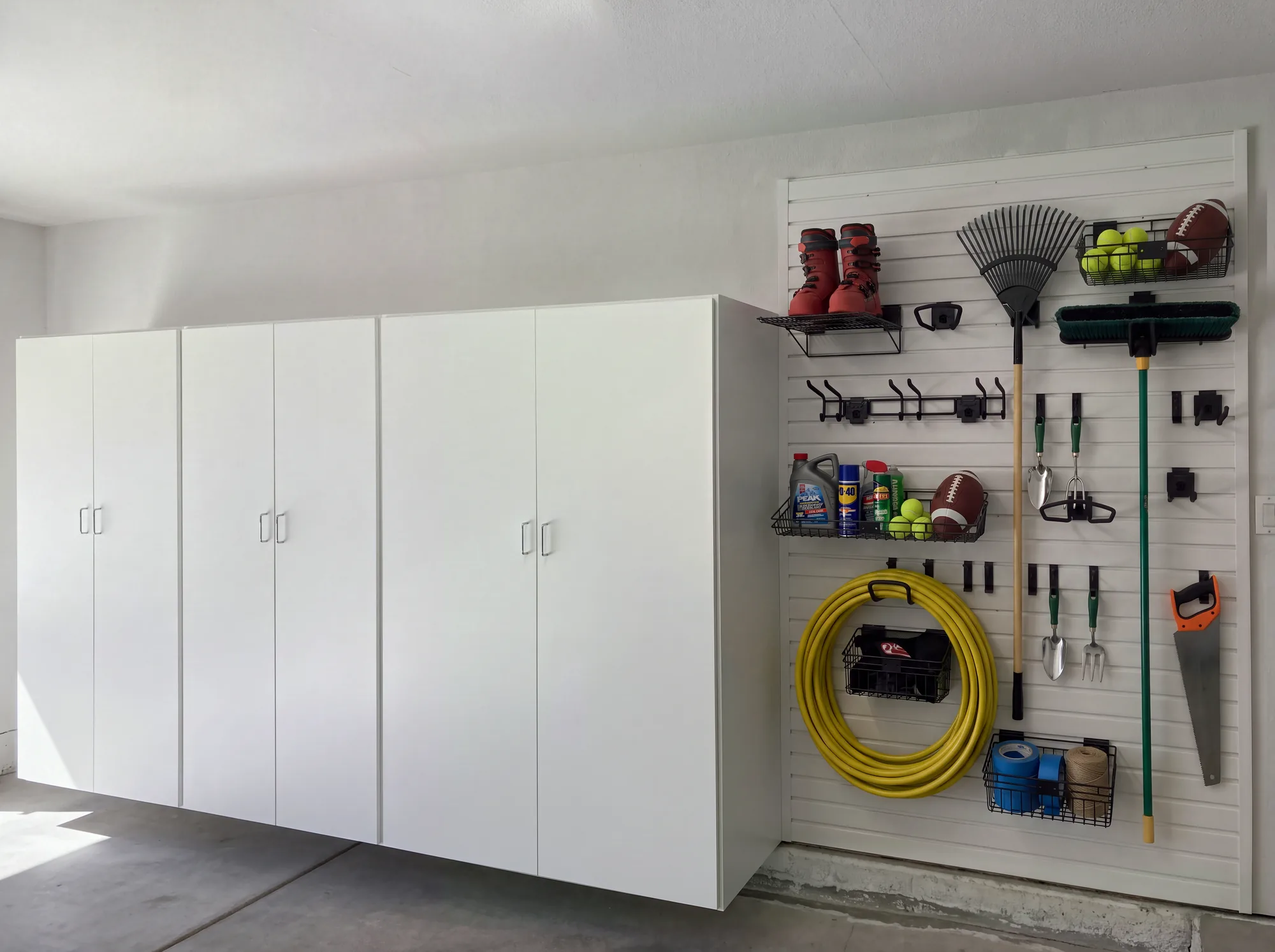
Our garage cabinets are built with industrial-grade particle board, finishes designed to resist moisture, heat, and heavy-duty wear, and aluminum trim on the adjustable shelves for added support. Each shelf is rated to hold up to 90 pounds without bowing. See our garage cabinets for finishes and configurations.
How much weight can garage cabinets hold?
Load capacity comes down to three things: the shelf, the span, and how the cabinet carries weight to the structure. Floor-standing cabinets send their load straight down to the concrete, so the shelf and its supports set the limit. Wall-hung cabinets hang every pound from their fasteners, so they're only as strong as their anchoring into studs. Drywall anchors are not a plan for a cabinet full of paint.
It helps to think in pounds per linear foot. A 90-pound shelf that's 36 inches wide holds about 30 pounds per foot. A gallon of paint weighs roughly 9 to 12 pounds, so a single row of gallons across that shelf is about 50 pounds. That's well within the rating, with room left for the painter's tape and the brushes you swore you'd clean.
Put the heaviest things low and the lightest things high. Partly that's for the shelves, and partly it's for you, since lifting a 40-pound box of leftover tile off a shelf at eye level is how a garage project becomes a chiropractor project. It matters in an earthquake, too, when heavy items on high shelves are the first to come down.
What size garage cabinets do you need?
Size cabinets to the garage you have, with the car in it. A typical two-car garage is about 20 by 20 feet at minimum and about 24 by 24 when it's comfortable. Plenty of midsize SUVs are close to 16 feet long, which in a 20-foot-deep garage leaves about 4 feet at the front for storage and walking combined.
Closet World garage cabinets come in these sizes:
| Cabinet type | Depths | Heights | Widths | Best for |
|---|---|---|---|---|
| Upper cabinet | 12-24 in (28 in when mounted on another cabinet) | 24-48 in | 14-48 in | Light items, and anything you want above bumper height. |
| Lower cabinet | 12-28 in (28 in on a platform) | 24-48 in | 14-48 in | Heavy items, with a worksurface on top. |
| Tall cabinet | 12-28 in (28 in on a platform) | 60, 72, 84, or 96 in | 14-48 in | Long-handled tools, sports gear, and the bulk paper towels. |
| Rolling cabinet | 16-24 in | 33 3/4 in, with a laminate top | 24-36 in | A worksurface that moves to the project instead of the other way around. |
Plan about 3 feet of walkway between the front of the cabinets and the car's bumper, and about 2 1/2 feet beside the car, so doors can open without chipping anything. In a shallow garage, that usually means 12- to 16-inch cabinets across the front wall and the deep ones on a side wall. Measure with the garage door closed and the car parked where it actually gets parked, not where it gets parked on its best day.
What should you not store in a hot garage?
Some of the most common garage items have temperature limits that a summer garage in the Central Valley or the Las Vegas Valley beats by lunchtime. Here's what to move, and where.
| Item | Heat limit | What happens | Store it instead |
|---|---|---|---|
| Aerosol cans | Avoid above 120°F | Pressure rises with heat, and cans can rupture. | A cool cabinet indoors, like a laundry room or hall closet. |
| Latex paint | Keep between 60°F and 80°F | Heat thickens paint and shortens its shelf life. | An interior closet, with the lid tapped down tight. |
| Lithium-ion batteries (tools, e-bikes, mowers) | Avoid sustained heat above about 104°F | Stored fully charged at 104°F, a battery can lose about a third of its capacity in a year. | Indoors at room temperature, charged to about 40 percent for storage. |
| Medications | 68°F to 77°F, with brief swings to 59°F-86°F | Potency can drop with heat. | A kitchen or bedroom cabinet, away from the bathroom's heat and steam. |
| Wine | 45°F to 65°F (55°F is ideal) | Above 70°F it ages fast, and hotter than that it "cooks." | An interior closet or a wine fridge. |
| Adhesives, caulk, and glue | Check the label, which usually says room temperature | Heat cures or separates them in the tube, so they're rock-hard the one day you need them. | The same indoor cabinet as the paint. |
| Propane cylinders | Don't store indoors | A leak in an enclosed space is a fire hazard. | Outside, upright, in a shaded, ventilated spot. |
The garage is still the right place for plenty of things: hand tools, garden tools, skis, surfboards, snowboards, bikes, and other sports gear, bulk paper goods, holiday decorations, and the camping equipment that gets used twice a year. The goal isn't an empty garage. It's a garage full of things that can take the heat.
Do garage cabinets need to be anchored for earthquakes?
Yes, anything tall should be secured. California's Office of Emergency Services advises securing the tops of tall, top-heavy furniture like bookcases and file cabinets to wall studs, not drywall, and FEMA's guidance on anchoring tall cabinets says the same. A 7-foot garage cabinet full of paint and tools is exactly what that guidance is about.
The water heater matters, too. Many California garages have one, and state law requires water heaters to be braced or strapped against earthquakes. Plan cabinets around it with enough room for service, and don't block the straps or the relief valve.
We install garage cabinets as a built-in system secured to the wall, with our own certified installers, not as freestanding boxes that leave you to go looking for the studs.
Garage cabinets are step two
Cabinets work best as part of a whole-garage plan, and the order of the work matters. If new flooring is on the list, it goes in before the cabinets, or you'll be coating around cabinet bases. The same goes for insulation, which lowers the garage's temperature and helps everything in the cabinets last longer. Our garage makeover guide walks through flooring, ventilation, and the order it all happens in.
Frequently asked questions
What is the best material for garage cabinets in a hot climate?
Materials that stay stable in dry heat hold up best: well-sealed melamine with banded edges, plywood, or powder-coated steel. Resin cabinets are the most likely to soften and warp in a hot garage.
How deep should garage cabinets be?
Upper cabinets are usually 12 to 16 inches deep, and lower and tall cabinets 16 to 24 inches. In a shallow garage, put 12- to 16-inch cabinets along the wall in front of the car and keep about 3 feet of walkway.
What should you not store in a hot garage?
Aerosols, latex paint, lithium-ion batteries, medications, wine, and adhesives all have heat limits that inland California and Las Vegas garages can exceed. Propane cylinders belong outside, not in the garage.
Built for the garage you actually have
A garage in the Western heat is a tough place to keep things, and the cabinets that last are chosen with that in mind. Pick materials that handle heat, sizes that leave room for the car, and anchoring that holds when the ground moves. Move the heat-sensitive things inside, and the garage can handle the rest.
We've been building custom garage storage for California and Las Vegas homes since 1991. Every cabinet is built in our own factory to your garage's measurements and installed by our own team. Book your FREE in-home design consultation, and we'll plan cabinets around your car, your water heater, and your summers.
Frequently asked questions
What is the best material for garage cabinets in a hot climate?
Materials that stay stable in dry heat hold up best: well-sealed melamine with banded edges, plywood, or powder-coated steel. Resin cabinets are the most likely to soften and warp in a hot garage.
How deep should garage cabinets be?
Upper cabinets are usually 12 to 16 inches deep, and lower and tall cabinets 16 to 24 inches. In a shallow garage, put 12- to 16-inch cabinets along the wall in front of the car and keep about 3 feet of walkway.
What should you not store in a hot garage?
Aerosols, latex paint, lithium-ion batteries, medications, wine, and adhesives all have heat limits that inland California and Las Vegas garages can exceed. Propane cylinders belong outside, not in the garage.
Should garage cabinets be attached to the wall?
Yes. Tall cabinets should be secured to wall studs, following Cal OES and FEMA earthquake guidance. Wall-hung cabinets depend entirely on their fasteners, so they need to go into studs, not drywall anchors.

CW Man’s two cents
Let’s plan the room you actually have
Your designer plans around your space, your things and your routine. Free in-home or virtual design consultation, in as little as 90 minutes.